Confused? Have a pressing question? Remember Lord Sri Ram and touch a square below.
॥ श्री राम ॥
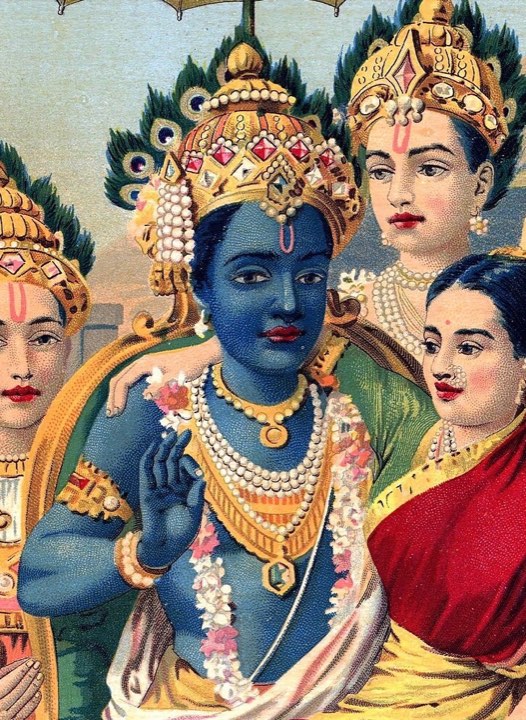
(before 1906) · Wikimedia Commons
Sri Ram Shalaka Prashnavali
How to ask
- Remember Sri Ram and let the mind settle.
- Hold one clear question.
- Touch any square, without deliberating.
- Read the chaupai and its meaning as the Lord's counsel.
The nine chaupais
- सुनु सिय सत्य असीस हमारी Auspicious
- प्रबिसि नगर कीजे सब काजा Auspicious
- उघरहिं अंत न होइ निबाहू Not favourable
- बिधि बस सुजन कुसंगत परहीं Not favourable
- होइहि सोइ जो राम रचि राखा Uncertain
- मुद मंगलमय संत समाजू Auspicious
- गरल सुधा रिपु करहिं मिताई Auspicious
- बरुन कुबेर सुरेस समीरा Uncertain
- सुफल मनोरथ होहुँ तुम्हारे Auspicious
Questions
How do I use the Ram Shalaka Prashnavali?
Remember Sri Ram, hold one clear question and touch any square. From that square every ninth syllable is gathered; the twenty-five syllables form one of nine chaupais of the Rama Charita Manas, which is your answer.
Is the Ram Shalaka a matter of chance?
No. It is an act of faith. The seeker remembers Sri Ram, holds one sincere question and accepts the chaupai that comes as the Lord's counsel – an answer received with devotion, not a result left to luck. Many traditions seek guidance in this way through their scripture. In the Sikh tradition, the Hukamnama is the hymn read when the Guru Granth Sahib is opened with reverence each day, and it is taken as the Guru's command. In Tamil Shaiva homes, a thread is placed in the Thirumurai and the hymn it opens to is read as the answer. In the Ram Shalaka, the counsel comes from Goswami Tulsidas's Rama Charita Manas.
Where does the Shalaka come from?
It is traditionally associated with Goswami Tulsidas and is printed in Gita Press, Gorakhpur editions of the Rama Charita Manas. The nine chaupais come from the Bal, Sundar and Lanka Kands.
What do the nine answers mean?
Five chaupais are auspicious, two counsel patience and surrender to the Lord's will, and two advise against the undertaking. Whichever comes, it is received as the Lord's counsel.
Can I ask the same question again?
Custom holds that a question is asked once, with a settled mind, and the answer accepted with faith. Ask again only when the question itself has changed.
Is this the Ramcharitmanas Prashnavali?
Yes. The chart and its nine chaupais come from Goswami Tulsidas's Rama Charita Manas – written variously as Ramcharitmanas, RamCharitManas, RamaCharitaManas or Ram Charit Manas – as printed by Gita Press, Gorakhpur.
Is Ramayan Prashnavali the same as Ram Shalaka?
Yes. Ramayan Prashnavali, Ramcharitmanas Prashnavali, Ram Shalaka and Ram Salaka are names for the same 225-letter chart and its nine chaupais.
What are the rules for asking?
Tradition asks for a clean body and a settled mind: remember Sri Ram, hold one sincere question, and choose a square without deliberating – in the printed book, by placing a shalaka (a fine stick) on the chart with eyes closed. Accept the answer with faith.
Can I ask on behalf of someone else?
Many families do, holding that person and their question clearly in mind. The same courtesy applies: one question, asked sincerely.
What if the answer is not favourable?
Read it as counsel, not a verdict. The unfavourable chaupais warn about pretence, bad company or reliance on force; the uncertain ones advise patience and surrender. Each page explains what the line asks of you.
Can I print the chart?
Yes. The printable chart page shows all 225 letters exactly as in the Gita Press table, ready to print on one sheet.
Is it free?
Yes. There is nothing to install and no sign-in.
About the Shalaka
The Sri Ram Shalaka Prashnavali – also known as Shri Ram Shalaka, Ramshalaka, Ram Salaka, Ramayan Prashnavali or Ramcharitmanas Prashnavali – is a traditional way of seeking guidance from Goswami Tulsidas's Rama Charita Manas – also written Ramcharitmanas, RamCharitManas, RamaCharitaManas or Ram Charit Manas. Its fifteen-by-fifteen chart holds 225 letters (akshars).
Beginning at the square you choose, every ninth syllable is gathered. The twenty-five syllables form one of nine chaupais, and that chaupai, with the episode it comes from, is the answer. The grid follows the table printed in Gita Press, Gorakhpur editions of the Manas.
Portrait: detail of Ramapanchayan, chromolithograph by Raja Ravi Varma (before 1906), public domain.